

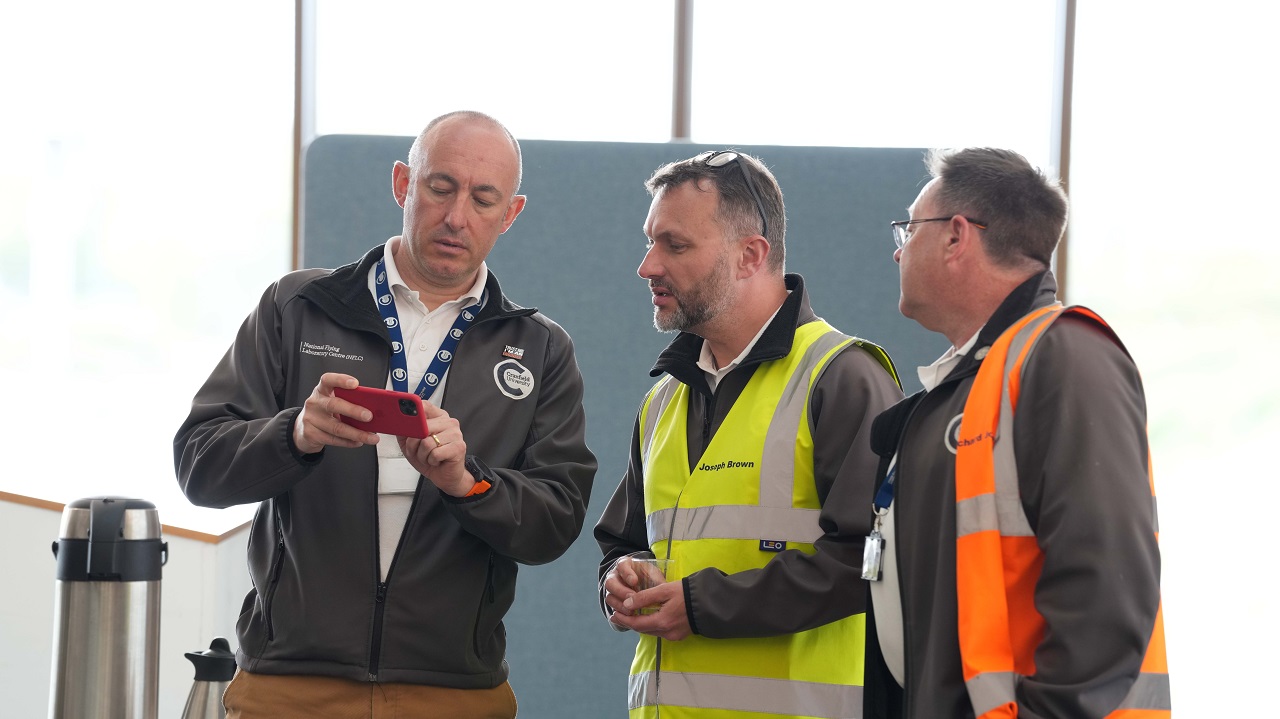
Viasat Inc., a global enabler in satellite communications, and partners Thales, Dimetor, TTP plc and the European Space Agency (ESA), have completed successful flight trials at Cranfield University using the National Flying Laboratory Centre’s Bulldog light aircraft, as part of the Iris RPAS programme.
The initiative is contributing to a coordinated effort to build real-world evidence around trusted, resilient connectivity for BVLOS uncrewed aircraft operations.
The trial forms part of the wider Iris airspace modernization programme, funded by ESA and industry partners, which is focused on enabling the safe integration of uncrewed aircraft into non‑segregated airspace through trusted communications. Iris brings together partners from across satellite communications, terrestrial networks, surveillance, airspace management, and secure aviation systems to understand how connectivity behaves under representative operational conditions.
The ongoing flight trials are explicitly evidence‑building in nature. They are designed to observe how different connectivity elements can work together within a multi‑link framework, reflecting the environmental and operational complexity expected as BVLOS activity scales.
How trusted multi-link connectivity is evolving for BVLOS operations
As BVLOS operations scale, it is increasingly recognized that extremely reliable command-and-control links are a critical prerequisite for meeting their high operational and safety requirements. ESA Iris RPAS trials explore how multi‑link connectivity models can support continuity, integrity, availability and trust, which are essential to maintaining safe command‑and‑control links and situational awareness in shared airspace.
Thales, as system integrator for Iris, is coordinating the trials to support a structured, safety‑led approach to connectivity evolution. Partners including Viasat, TTP plc, Dimetor and Cranfield University contribute complementary capabilities spanning satellite communications, satcom terminals (TTP) and flight planning support tools (Dimetor), terrestrial networks, and surveillance and airspace intelligence, helping to build a holistic view of trusted connectivity for future operations.
What the Iris RPAS trials show for future uncrewed aviation
“For BVLOS uncrewed operations, safety depends on having a command‑and‑control link that can be trusted wherever the aircraft is operating,” said Joel Klooster, SVP Aircraft Operations and Safety at Viasat. “Satellite communications play a critical role in providing that assurance, particularly beyond the reach of terrestrial networks. Through Iris RPAS, we are working with our partners to build evidence around how satcom can contribute to resilient, safety‑oriented multi‑link architectures that support the next phase of uncrewed aviation.”
These flight trials are one of several activities being delivered through the ESA Iris RPAS programme, each designed to examine connectivity behaviour across different operational scenarios and environments. Together, these trials are building a cumulative evidence base to support collaboration between industry, regulators and airspace stakeholders, helping to inform how trusted, multi‑link communications can safely enable the continued growth of BVLOS uncrewed aviation.
Jim Baddoo, Senior Expert at Thales said “We were delighted to demonstrate our trusted multi-link connectivity solution on a real flight to a live audience, realizing secure and high-availability connectivity in a very dynamic satcom, cellular and C-band radio environment. This was an important step as we mature the system for real-world deployment.”
Thomas Neubauer, CEO & Co-Founder of Dimetor said ““For remotely piloted aircraft systems, situational awareness on knowing where, when and at what quality terrestrial and non‑terrestrial connectivity are available in the airspace is critical to safe and scalable operations. Because automated drone operations are only as safe and reliable as the data they run on, we are very excited that our AirborneRF and AirborneRF HUB solutions are delivering this real-time information to ensure that every decision in remote airspace is accurate, timely, resilient and trustworthy.”
Professor of Space Engineering at Cranfield University, Paul Febvre, said “Cranfield’s unique digital aviation facilities and expertise in satellite communications and resilient navigation enables partners to undertake exciting trials like this, building knowledge and evidence in complex airspace connectivity. This kind of exercise is vital in developing the case for regulators and industry on future technology integrations.”
Martin Wallis, IRIS Programme Manager said “a secure, reliable command and control link is essential for BVLOS operations. As part of the IRIS programme, TTP developed low size, weight SWaP-c terminal and antenna technology for Viasat’s Velaris network, designed specifically for UAVs. These terminals provide the critical satcom component of BVLOS connectivity, and we are delighted that these terminals, provided by TTP brand Gotonomi, were able to play a key part in this flight trial.”
