


As one of the world’s biggest sporting extravaganza – 2026 FIFA World Cup is now underway – a quiet but crucial ritual unfolds in locker rooms across the United States, Canada, and Mexico. Match balls are placed on wireless charging pads. This is the new reality of modern football, where the official match ball is no longer just leather and polyurethane—it is a piece of wearable technology.
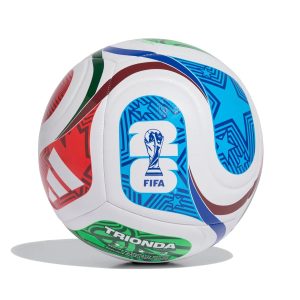
The Adidas TRIONDA, the official match ball of the 2026 FIFA World Cup, represents a significant leap forward in how the beautiful game is tracked, analyzed, and officiated. While its vibrant red, green, and blue design pays homage to the tournament’s three host nations, the real story is hidden beneath its surface. At the heart of this innovation is a hidden sensor that allows the ball to communicate with the Video Assistant Referee (VAR) system in real-time, tracking its every move 500 times per second.

The Hidden Brain: Inside the TRIONDA
Unlike traditional balls, the TRIONDA utilizes a 500Hz inertial measurement unit (IMU) motion sensor chip. This sophisticated piece of technology, which weighs approximately 14 grams, records data on the ball’s speed, spin, trajectory, and directional changes. More critically, it detects the exact millisecond a player makes contact with the ball, identifying the precise point of touch.
The engineering behind the sensor’s placement is just as impressive as the sensor itself. For the 2022 World Cup in Qatar, the “Al Rihla” ball featured a sensor that was centrally suspended inside the ball using wires. For the TRIONDA, Adidas and its technology partner completely redesigned the architecture. The new sensor is side-mounted, embedded directly into a specialized layer within one of the ball’s four panels. To ensure this doesn’t unbalance the ball mid-flight, counterweights have been added to the other three panels. This seamless integration ensures that the ball behaves naturally, maintaining the perfect bounce, weight, and feel that professional players demand.
Company Behind the Sensor?
A key detail for those tracking the technology powering the tournament is the origin of this high-tech chip. The sensor inside the TRIONDA was developed in close collaboration with Kinexon, a Munich-based technology company.
Kinexon specializes in high-precision real-time data and Artificial Intelligence for sports. The company worked alongside FIFA and Adidas to perfect the “Connected Ball Technology,” ensuring that the data captured by the chip is transmitted instantly to the VAR room. This partnership allows the system to combine the ball’s sensor data with optical tracking cameras positioned around the stadium, creating a live, digital 3D model of the game.
Powering the Future: Why the Ball Needs a Charge
Because the sensor is constantly transmitting data, it requires power. Each TRIONDA ball is equipped with a rechargeable battery that lasts approximately six hours on a full charge. Given that a match lasts 90 minutes plus extra time and pre-game warm-ups, six hours provides a comfortable safety buffer.
The charging process is entirely wireless. Officials place the ball on a specialized pad for about 90 minutes before kick-off to reach full capacity . When the ball is stationary, the sensor automatically enters a “hibernation” mode to conserve battery life, waking up instantly when the ball is put back into play.
From Shenzhen to the World Stage
While the chip is designed in Germany, the physical production of the TRIONDA ball involves global manufacturing expertise. Reports indicate that the balls are being mass-produced in a specialized Adidas football manufacturing facility in Shenzhen, China—a factory that has produced official match balls for several previous World Cups.
This fusion of German engineering, Asian manufacturing, and global sporting infrastructure highlights how technology has become as essential to the World Cup as the players on the pitch. The TRIONDA is not just a ball; it is a data-harvesting device that helps officials make faster offside calls, identifies handballs, and gives fans unprecedented insight into the split-second physics of the game.
