

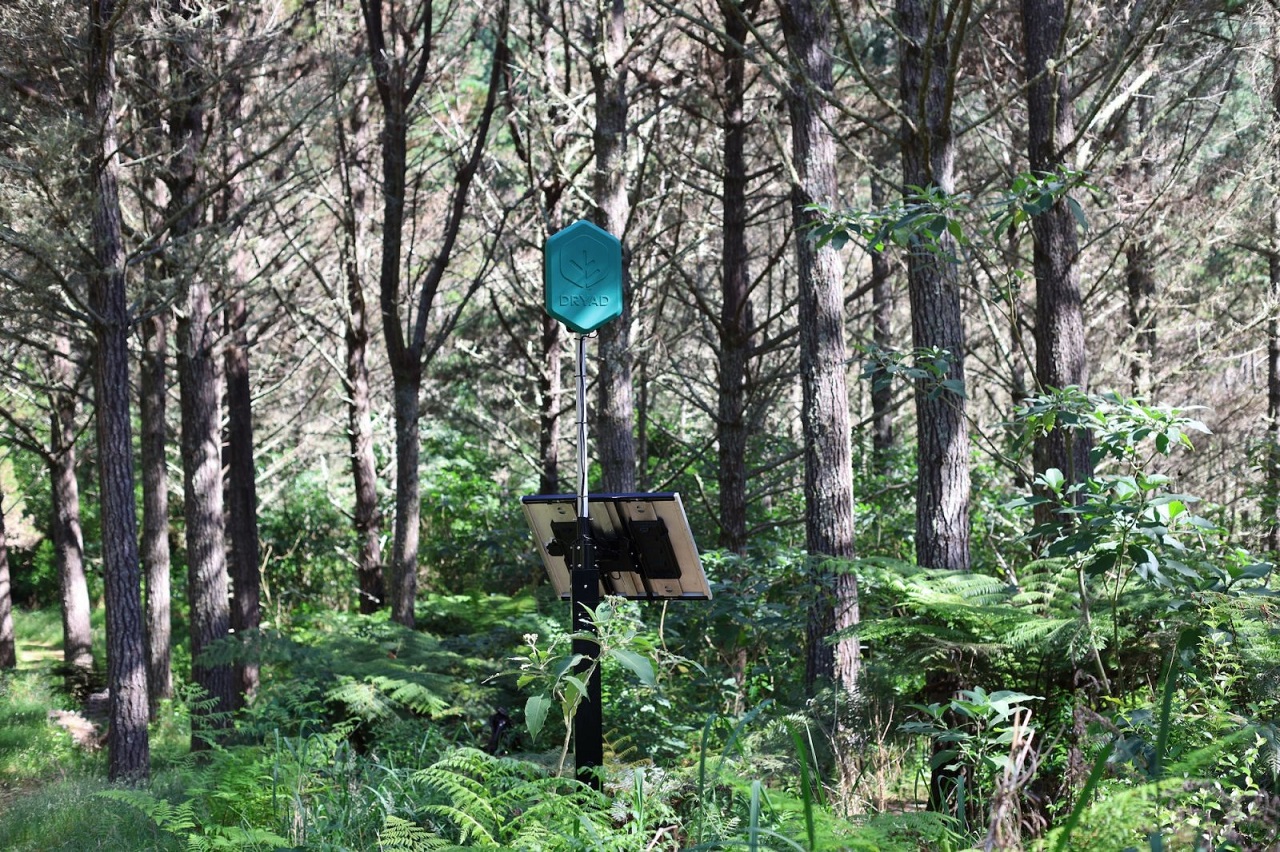
Spark, the Far North District Council (FNDC) and Dryad have implemented an advanced ultra-early fire detection system at the Waitangi Endowment Forest – the first of its kind in New Zealand.
This initiative aims to safeguard one of New Zealand’s cultural landmarks by providing state-of-the-art protection against wildfires, using sensors that are ‘trained’ to detect variations in air quality and presence of pollutants associated with smouldering and smoke. The system will learn to recognise smoke based on the native tree and shrub species, other vegetation and the soil type unique to Waitangi.
The project will use Dryad’s Silvanet system, which is a network of sensors spread throughout the park. These solar-powered sensors use artificial intelligence to detect fires early and then issue an alarm to FNDC and the Waitangi Endowment Forest who alert Fire and Emergency. The sensors are designed to detect traces of smouldering even if there isn’t visible smoke or fire. This gives more time to respond, including faster evacuation of the park and alerting Fire and Emergency sooner.
Spark, through its company Adroit, is bringing the new fire detection technology to Waitangi Forest. Adroit will deploy and configure the system, connect it to the internet and make sure everything works smoothly. FNDC will install the sensors in the forest and will match funding provided through Round 7 of the Tourism Infrastructure Fund administered by Ministry of Business, Innovation & Employment.
By extending Spark’s IoT networks into the Waitangi Endowment Forest, this initiative is pioneering the concept of a ‘smart forest’ – using connected sensors and intelligent monitoring to protect and sustain New Zealand’s natural heritage, along with protecting the substantial community investment and infrastructure that sits within this forest, as well as safeguarding the hundreds of people who use the area every week.
Waitangi Endowment Forest was created by the Waitangi Endowment Act 1932-33 and gifted to the nation. The forest is managed by the Department of Conservation on behalf of the Waitangi National Trust Board. The forest is home to native species like the North Island Brown Kiwi and contains the popular Waitangi Mountain Bike Park.
There will be 250 wildfire sensors installed across the forest. This means the whole park will be covered by sensors that will help spot fires quickly and also monitor forest health and growth. Installation of the set-up has been authorised by the Department of Conservation for a period of 15 years.
“At Spark, we are committed to leveraging innovative technology to protect New Zealand’s natural and cultural heritage. The deployment of this system at Waitangi Endowment Forest is a testament to our dedication to environmental conservation and community safety,” says Liz Urquhart, Spark’s General Manager of Business Products and Services.
FNDC Group Manager for Corporate Services, Charlie Billington says the Waitangi Endowment Forest and the Waitangi Bike Park are cherished assets for our community and visitors alike. “By partnering with Spark and Dryad, we are taking proactive steps to ensure its preservation against the threat of wildfires. By training the AI to detect fire specifically from our local flora – this localises the technology and makes it more accurate.”
“We are excited to bring our Silvanet technology to New Zealand, where it can play a vital role in protecting the unique biodiversity and cultural sites. Our collaboration with Spark and the Far North District Council is a significant step towards reducing the impact of wildfires,” commented Carsten Brinkschulte, Co-founder and CEO, Dryad.
The project underscores the importance of using cutting-edge technology to address environmental challenges and protect valuable ecosystems. Spark, FNDC, and Dryad are committed to working together to ensure the safety and sustainability of the Waitangi Bike Park for future generations.
In February next year there are plans to walk the forest with forest managers and owners, iwi and industry representatives to explain and promote the fire detection system. Once it has been in place and any teething problems have been resolved, the network will be further fine-tuned and refined to recognise specific smoke signatures from local flora like mānuka. It is hoped the system can also be integrated with FENZ (Fire and Emergency New Zealand) systems.
