In an era where high-speed internet is a necessity, traditional methods of connectivity—such as fiber optics and wireless networks—face challenges in remote and underserved areas. To bridge this gap, Taara, a project under Alphabet’s X (formerly Google X) , is pioneering an innovative solution: using beams of light to deliver fast, reliable internet.
What is Taara?
Taara employs Free Space Optical Communication (FSOC) , a technology that transmits data through invisible light beams between two terminals. Similar to fiber optics but without physical cables, Taara’s wireless optical links can deliver gigabit-speed internet over distances of up to 20 kilometers, even in challenging terrains.
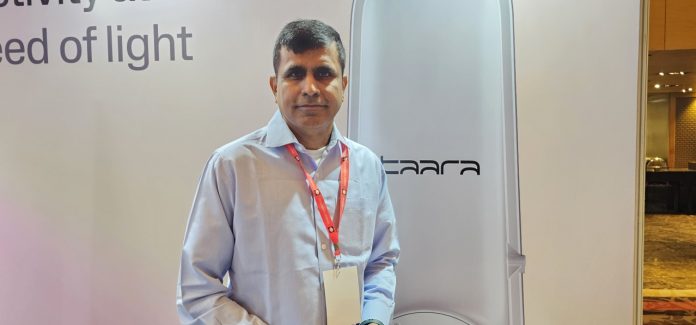
Speaking on the sidelines of Bharat 6G 2025 event – Mahesh Krishnaswamy, Founder & CEO, Taara explained how Taara is driving innovation in delivering high-speed connectivity with light.
“Today, we have our first generation product which is called as the Tara Light Bridge – this allows you to essentially extend fiber connectivity to places that don’t have fiber and we do this in a wireless way. And as a result, our customers get the best of both worlds where you get the speeds of fiber but with the flexibility of wireless. This allows our customers to cover areas which are otherwise unable to be covered by fiber.
This can also be used to enhance radio frequencies if you’re running out of radio frequencies: could be microwave or could be millimeter wave and you need higher throughput. So basically, it allows you to future proof your network,” he added.

How Does It Work?
Taara’s system consists of small, AI-powered terminals mounted on towers or rooftops. These terminals align narrow, high-speed light beams to establish a connection. Here’s how it functions:
- Light-Based Transmission – Instead of radio waves (used in Wi-Fi and 5G), Taara uses infrared lasers to send data as pulses of light.
- Precision Alignment – Advanced tracking systems ensure the beams stay aligned, even in windy conditions or minor structural shifts.
- Weather Resilience – While fog and heavy rain can affect performance, Taara’s software adjusts signal strength dynamically to maintain stable connections.
Advantages Over Traditional Methods
- Cost-Effective Deployment – Laying fiber cables is expensive and time-consuming, especially in difficult terrains. Taara’s wireless optical links can be set up in days , reducing costs significantly.
- High-Speed Connectivity – With speeds comparable to fiber optics, Taara can support video calls, streaming, and cloud services seamlessly.
- Scalability – The technology is ideal for extending connectivity to remote villages, disaster-struck areas, and urban locations where digging for cables is impractical.
Connecting the unconnected – the wireless way – Taara’s connectivity solution works in a unique manner – “If you have a village that is not fiberized or there is no access to it, you can take it from the closest point of fiber which could be a tier two or tier one town and from there you can extend the connectivity using our solution. And as a result, you can provide fiber like speeds to a remote rural area,” he explained.
Real-World Applications
Taara has already been deployed in multiple regions, including:
– India – Partnering with local telecom providers such as Bharti Airtel – to bring high-speed internet to rural areas.
– Africa – Supporting Econet Group in Kenya to enhance connectivity without costly infrastructure.
– Urban Settings – Providing backhaul connectivity for 5G networks in cities where fiber deployment is challenging.
Taara has also been Partnering with T-Mobile to provide 5G connectivity for hundreds of thousands of attendees at two major U.S. events – Coachella and the Albuquerque International Balloon Fiesta.
With advancements in AI and adaptive optics, Taara aims to improve reliability and expand its reach. As the demand for global connectivity grows, light-based internet could revolutionize how we stay connected, especially in underserved regions.
The Road Ahead…
Taara represents a bold step toward affordable, high-speed internet for masses. By harnessing the power of light, it offers a flexible, scalable alternative to traditional broadband solutions. As the technology matures, Taara could play a crucial role in bridging the digital divide , bringing the world closer together—one light beam at a time. With continued innovation, Taara’s vision of universal connectivity may soon become a reality.