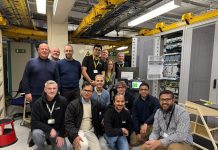
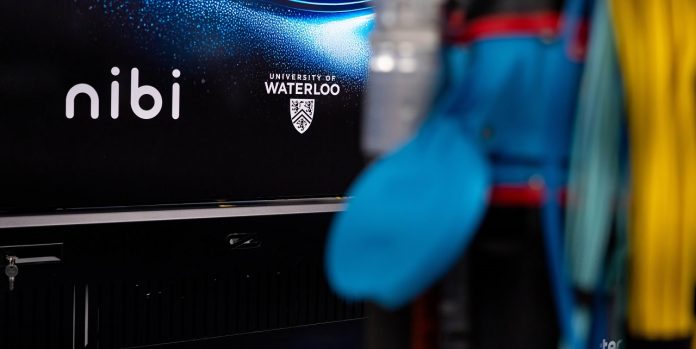
Nokia, a world-class leader in IP networking and AI-HPC data center fabric, and Hypertec, a global enabler in large-scale AI and HPC infrastructure, celebrated the successful deployment of Nibi, an advanced supercomputing cluster at the University of Waterloo. This new system is designed to support more than 4,000 researchers annually, significantly expanding Canada’s capacity to advance breakthrough research in health, climate science, engineering and AI.
Nibi represents Nokia’s first deployment of this class of AI-HPC data center networking in North America and showcases a world-class collaboration with Hypertec, which acted as the system architect and prime integrator. This project reflects Canada’s growing ability to design, deploy and operate globally competitive sovereign AI research infrastructure, anchored in domestic expertise.

SHARCNET is a world-class, high-performance computing environment that allows faculty, students, postdocs, and research fellows at Canadian academic institutions access to computational power for research. SHARCNET includes a total of 19 academic partner institutions, making it the largest HPC consortium in Canada by number of institutions, and its resources are available to any Canadian academic researchers.
The project combines Nokia’s industry-leading Data Center Fabric and IP networking with Hypertec’ s expertise in AI-HPC data center design and system integration. Hypertec’ s advanced immersion-cooling capabilities, paired with Nokia’s high-performance fabric, were key differentiators to the success of the deployment.
John Morton, Director of Technology at SHARCNET, said, “With the Nibi supercomputer, we made the move to an Ethernet-based interconnect, and the combined solution delivered by Hypertec and Nokia proved to be a perfect fit. Nokia’s performance networking combined with Hypertec’s system integration expertise gives our research community the scalability, reliability, and performance needed to support a wide range of demanding workloads.”
Charmaine Dean, Vice-President, Research and Professor in the Department of Statistics and Actuarial Science at the University of Waterloo, commented, “The Nibi supercomputer significantly expands Waterloo’s capacity to support advanced computational research. By working with Nokia and Hypertec, we gain access to world-class AI and high-performance computing infrastructure that combines scalable system design with high-performance Ethernet networking, advancing the next generation of Canadian research and reinforcing Waterloo’s long-standing leadership in computation.”
Mike Marracino, President, Hypertec Solutions Partner (HSP), said, “This collaboration with Nokia proves that Canada can design and deploy AI and high-performance computing infrastructure at the highest global standards. Hypertec works with universities, enterprises and governments around the world on the most demanding AI workloads. Bringing that capability to SHARCNET gives Canadian researchers truly world-class infrastructure and strengthens Canada’s competitiveness in advancing research and AI.”
Jeff Maddox, President of Nokia Canada, commented, “This project will be key to maintaining Canada’s global leadership in computer science and innovation in the AI era. This is a very important day for Nokia Canada, and we are looking forward to more exciting joint projects with Hypertec Group, SHARCNET and the University of Waterloo.”
The Nokia Data Center Fabric is a high-capacity data center switching platform built for the AI era, based on a modern network operating system (NOS) and a quality-first design. It adapts easily to existing ecosystems, environments, and processes, and helps drive human error to zero, thanks to its reliable and automated architecture.
Nokia’s strong footprint in Canada
Nokia is entering a bold new chapter in Canada with the groundbreaking of its next-generation Ottawa campus, a major investment that strengthens the country’s position as a global hub for connectivity and innovation.
Building on more than five decades of technological leadership in the region, the new nearly 750,000-square-foot campus in Kanata North Tech Park will accelerate advances in AI-powered networks, data center networks, quantum-safe infrastructure, and next-generation 6G technologies. It will also deepen strategic partnerships and foster the next wave of Canadian innovators, reinforcing the Ottawa site as one of the largest and most advanced hi-tech R&D hubs in the nation.
Nokia’s roots in Canada trace back to 1989 with Newbridge Networks, and through the evolution of Alcatel and Alcatel-Lucent, the company became part of Nokia in 2016—solidifying its focus on world-leading networking technologies. Today, with more than 2,700 employees nationwide, Nokia continues to drive Canadian innovation.