
When companies ship products, they issue a paper delivery note that accompanies the shipment until the goods are received. It is passed on and processed manually. This is time-consuming, error-prone and consumes resources.
The digital delivery note will soon solve these problems. The solution was tested in practice in a joint pilot project by the nonprofit logistics association BVL (Bundesvereinigung Logistik), GS1 Germany and T-Systems. 20 companies from the consumer goods industry, retail and logistics tested the digital delivery note for four weeks in August and September. Successfully: 68 percent of the users surveyed would like to continue using the standardized industry solution for the digital processing of delivery notes.

According to the results, the duration of individual delivery processes was reduced by up to ten days. “Freight forwarders no longer have to spend time and effort documenting delivery notes – from scanning to archiving up to the obligation to provide information,” says Oliver Püthe, heading the project at GS1 Germany. The detailed results of the pilot project were presented at the digital symposium “Paperless Logistics” on October 6, 2021.
In the course of the project, participants particularly liked the contactless handover of the document using the QR code scan, the digital signature, and the avoidance of delivery note printing. They also welcomed the fact that the quality of the document does not suffer due to multiple manual pass-throughs. In their opinion, the advantages also include the timely and complete availability of proofs of delivery, including the easy-to-read information on delivery deviations.
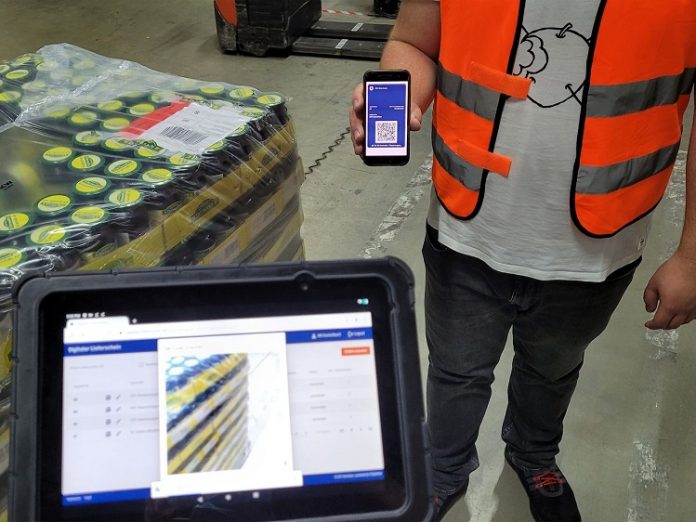
In the goods receiving department tablet and smartphone serve for goods receipt.
Scan of the QR code for accessing the digital delivery note in the goods receiving department.
“The digital delivery note is an important element for end-to-end digital business processes in transport logistics,” says Christian Grotemeier, Managing Director of BVL. In the future, every partner in the supply chain will be able to access their delivery notes digitally, comment on them and confirm them with a signature.
The digital delivery note is operated as a web app in the Open Telekom Cloud. Everyone involved in the delivery process has access according to precisely defined rights. As a first step, the shipping companies upload the delivery notes. To ensure that the digital document can be clearly assigned to the respective delivery, they use the GS1 standard GDTI (Global Document Type Identifier).
During loading, the driver scans a QR code with his or her smartphone camera. This gives him or her temporary, secure access to the digital delivery note in the cloud. This also contains a QR code. It is presented upon delivery. The recipient scans the displayed QR code from the driver’s smartphone and electronically confirms receipt of the goods.
This enables the subsequent steps to be triggered directly, such as the creation of a delivery receipt and invoices to the retailer and freight forwarder. The process is secure: “Processing the data via Open Telekom Cloud ensures the best possible availability and complies with data protection in accordance with European standards,” says Ludger Vennewald, responsible for Sales Mobility, Transport & Logistics at T-Systems.
After evaluation of the pilot project, the digital delivery note will be further developed. In addition, a GS1 application recommendation will be created to support companies in its implementation. The first concrete applications are expected to be available as early as 2022.