

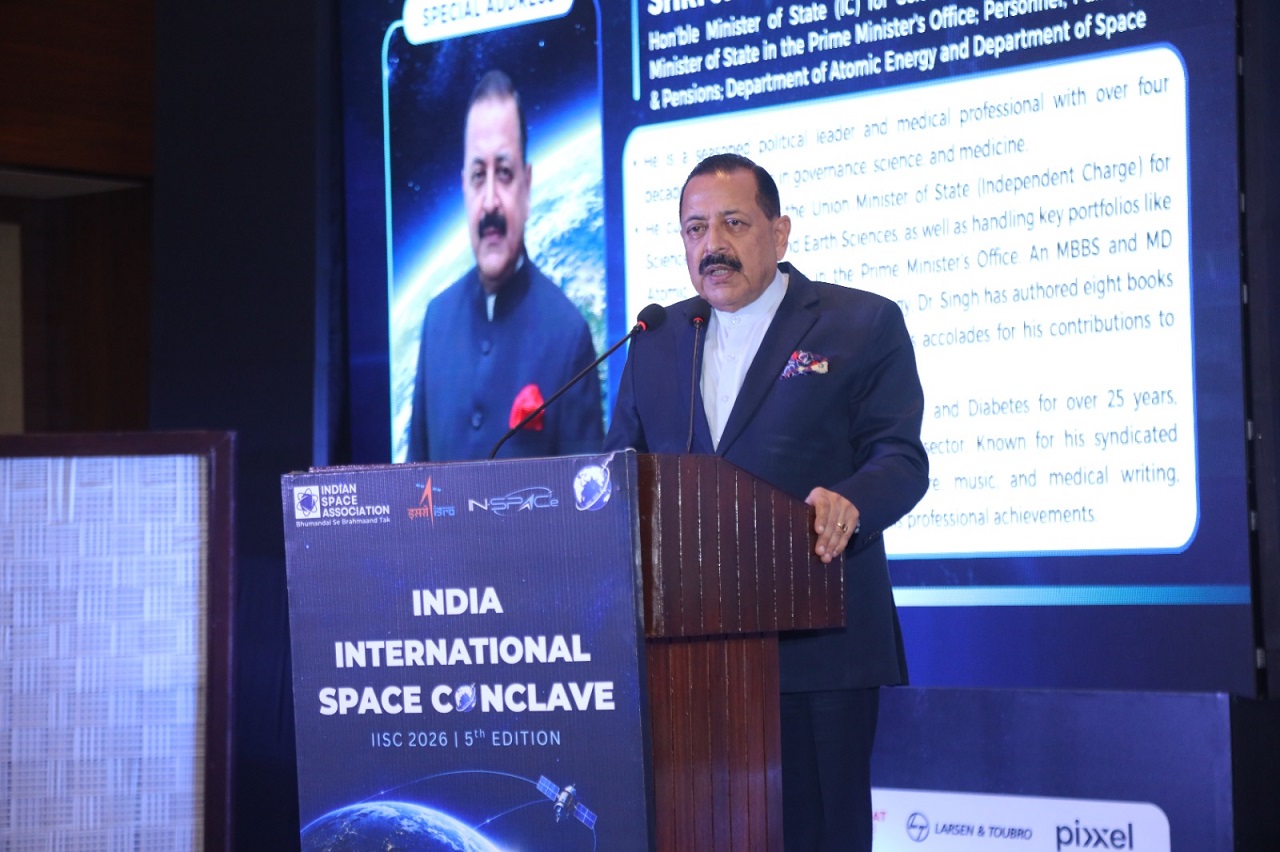
Highlighting the expanding role of space technology beyond traditional space missions, Dr. Jitendra Singh, Hon’ble Union Minister of State for Science & Technology, Earth Sciences and Space, said that more space technology is being deployed on the surface of the Earth than in space itself, underlining its growing relevance across sectors and applications, speaking on the concluding day of the 5th India International Space Conclave organised by the Indian Space Association (ISpA) in New Delhi.
Dr. Jitendra Singh, Hon’ble Union Minister of State for Science & Technology, Earth Sciences and Space said, “When the space sector was opened up to private players, there were a lot of discussions and some amount of cynicism. Looking back, I think we stand vindicated. From a single-digit number of startups, today we are close to 400 to 500, some of them with global potential. From almost a decimal economy, we are today close to 9 billion US dollars, and we hope to be about 40 to 45 billion in less than one decade. The talent and potential in this country were always there. It was just unleashed and enabled by the reforms. More than the amount of space technology being deployed in space, much more is being deployed on the surface of the Earth. We need to scale investments from domestic private players, and investment from overseas is something that our business leaders could facilitate. We have brought in a lot of reforms and are open to suggestions to make doing business easier.”
The two-day conclave witnessed participation from over 1,000 attendees, bringing together policymakers, global leaders, space agency representatives, defence leaders and industry stakeholders. The second day witnesses dignitaries including Dr. Jitendra Singh, Hon’ble Union Minister of State for Science & Technology, Earth Sciences and Space; Dr. V Narayanan, Secretary, Department of Space, Chairman, Space Commission and Chairman, ISRO; H.E. Mr. Christian Biever, Ambassador, Grand Duchy of Luxembourg, Embassy of Luxembourg in India; Pawan Goenka, Chairman, IN-SPACe; Maj Gen Brian A. Denaro, Commander, U.S. Space Forces Indo-Pacific; and AVM Manu Midha, Director General, DSA, who underlined the need to translate the country’s growing space capabilities into scalable industrial capacity, sustained demand and greater global competitiveness. The Indian Astronauts Gp. Capt. Shubhanshu Shukla, Astronaut; and Gp. Capt. Angad Pratap, Astronaut Designate, ISRO were also present on the second day of the conclave. Following his address, Hon’ble Minister Dr. Jitendra Singh also had an engaging and interactive Q/A session with the audience, which was the major highlight of the conclave.
Dr. V Narayanan, Secretary, Department of Space, Chairman, Space Commission and Chairman, ISRO said, “Today, we are extremely happy that 440 startup companies are working in the space area. Whenever a launch vehicle lifts off or we place a satellite, 70 to 80 percent of the budget is pumped into the Indian industry. Without the support of Indian industry, we would not have reached the present level. When you talk about navigation, we are going to launch three more satellites in the next one-and-a-half years to establish our regional navigation constellation, but what is required is to convert it into a global constellation. In the area of national security, the demands are huge in terms of the number of satellites and space assets required to protect the entire country. We also need to develop basic R&D capabilities in the country, particularly in areas such as optics, and reduce import content while building the entire capability within the country.”
H.E. Christian Biever, Ambassador, Grand Duchy of Luxembourg, Embassy of Luxembourg in India said, “Space transcends national borders. Its opportunities are global, its challenges are shared and its future cannot be shaped by one nation alone. India’s rapidly expanding space ecosystem, supported by private enterprise, ISRO and a new generation of innovation, offers immense opportunities for international collaboration. Our strengths are very complementary. India brings scientific and engineering capabilities, a dynamic industrial base and an ambitious vision of the future, whereas Luxembourg brings long-standing expertise in satellite communication, a specialised space industry and experience in developing regulatory frameworks for emerging space activities. Together, we can strengthen cooperation in satellite communication, Earth observation, research and space resources.”
During a fireside chat with industry leaders, Pawan Goenka, Chairman, IN-SPACe, highlighted key priorities and challenges for the industry’s next phase of growth, extending the discussion beyond the immediate perspectives of the participating companies. “The first phase of India’s space reforms opened the sector and created an institutional framework for private participation. Now India has to work on generating heavy demand. I have less concern about capacity being created; I see a bigger need for demand to be created. The second is to have enough money coming into the sector, and number three, to have procedures at all levels. Space is not a sector that is going to give you a payback in six months or nine months. Perseverance is required, and the government must continue to have policy stability. Today, government departments, both central and state, are looking at space applications in a big way because we now realise the value the space sector can bring to governance. I feel optimistic about the future, but make sure that you do not take any shortcuts. There are no shortcuts in this space,” said Pawan Goenka, Chairman, IN-SPACe.
While having an interaction with the industry in a closed-door roundtable, Maj. Gen. Brian. Denaro, Commander, U.S. Space Forces Indo-Pacific expressed his appreciation on the capabilities and capacities of Indian Industry which has a huge potential of cooperation between the two nations. “Space is no longer an isolated, exotic frontier. It is the connected tissue of our global economy, underpinning modern navigation, agricultural logistics, disaster early warnings, financial transactions and real-time maritime domain awareness. Shared security requires shared responsibility, while effective collaboration must respect India’s foundational strategic autonomy. Our operational philosophy is ‘partnered by design’, prioritising interoperability, strengthening relationships with allies and partners and leveraging industry’s speed and innovation. Traditional acquisition timelines that take a decade to field a system are fundamentally obsolete. We are moving from a culture of compliance to one of speed and execution through rapid, iterative development”, said Maj. Gen. Brian. Denaro, Commander, U.S. Space Forces Indo-Pacific.
AVM Manu Midha, Director General, DSA said, “Strategic autonomy in space is fundamentally predicated on building an indigenous, end-to-end, sovereign space industrial base. Self-reliance is not merely an economic aspiration, it is an operational necessity. In times of crisis or conflict, assured access to orbital technology, sovereign satellite constellations and responsive launch capabilities can only be ensured through design, development and manufacture in India. The private sector and startups are no longer spectators; they are strategic partners in defence, developing space situational awareness sensors, high-resolution electro-optics, satellite buses and secure quantum-resistant communication capabilities. We must align industry R&D roadmaps with the operational requirements of the three services.”
Lt. Gen. AK Bhatt (Retd.), Director General, Indian Space Association (ISpA) said, “India’s private space industry has made remarkable progress in a relatively short span, with advancements in launch vehicles, satellite constellations, Space Situational Awareness and in-space servicing, assembly and manufacturing. The conclave has brought together stakeholders from across the global space ecosystem to deliberate on the opportunities and challenges shaping the sector. One of the key priorities for India’s next phase of growth is patient, informed capital that understands the long gestation periods and risks associated with the space industry. We must move beyond discussions and build meaningful collaborations that translate into tangible outcomes for the industry.”
As the conclave drew to a close, it marked another milestone in strengthening global space-sector engagement, with this year’s edition witnessing participation from multiple countries including Japan, France, the United States, Luxembourg, South Korea, Indonesia, Oman, Australia and Russia.
On the concluding day, the conclave witnessed discussions across a range of emerging priorities shaping the global space ecosystem, including India-Japan space cooperation, downstream applications of Earth observation and geospatial intelligence, regulatory frameworks for SATCOM and spectrum allocation, space exploration beyond satellites, and the role of human potential in the space economy. Sessions also examined strategic materials for space and defence, industry demand, skilling and youth participation, and the development of a future-ready space workforce.
The forum witnessed the launch of four publications offering perspectives on key areas of the evolving space economy. The Uninsured Orbit, authored by Mr. Madhan Kumar, CEO, OrbiX Global, addresses the importance of space insurance and risk management. The IDS2026 Tech Report, developed in association with Amity University, presents insights into emerging technologies and developments in the sector. Space Economy 2036: The India BluePrint, authored by Mr. Akshat Johri, was also released, with an introduction to the book delivered by Group Captain Shubhanshu Shukla, Astronaut, ISRO. The fourth publication, Venture Capital, Foreign Investment and the Architecture of Strategic Autonomy, authored by Dr. Ravinder Pal Singh, was also released, highlighting the role of investment and strategic autonomy in shaping India’s space ecosystem.
